.avif)

.avif)
.avif)
This week felt encouraging.
Not because the pressures facing mothers have suddenly changed, or because the systems around care, childcare, employment, and postnatal support have been fixed, but because the conversation seems to be moving in a direction that many mothers have been asking for, often quietly and for a very long time.
Support for mothers is beginning to move out of the private space and into the public conversation.
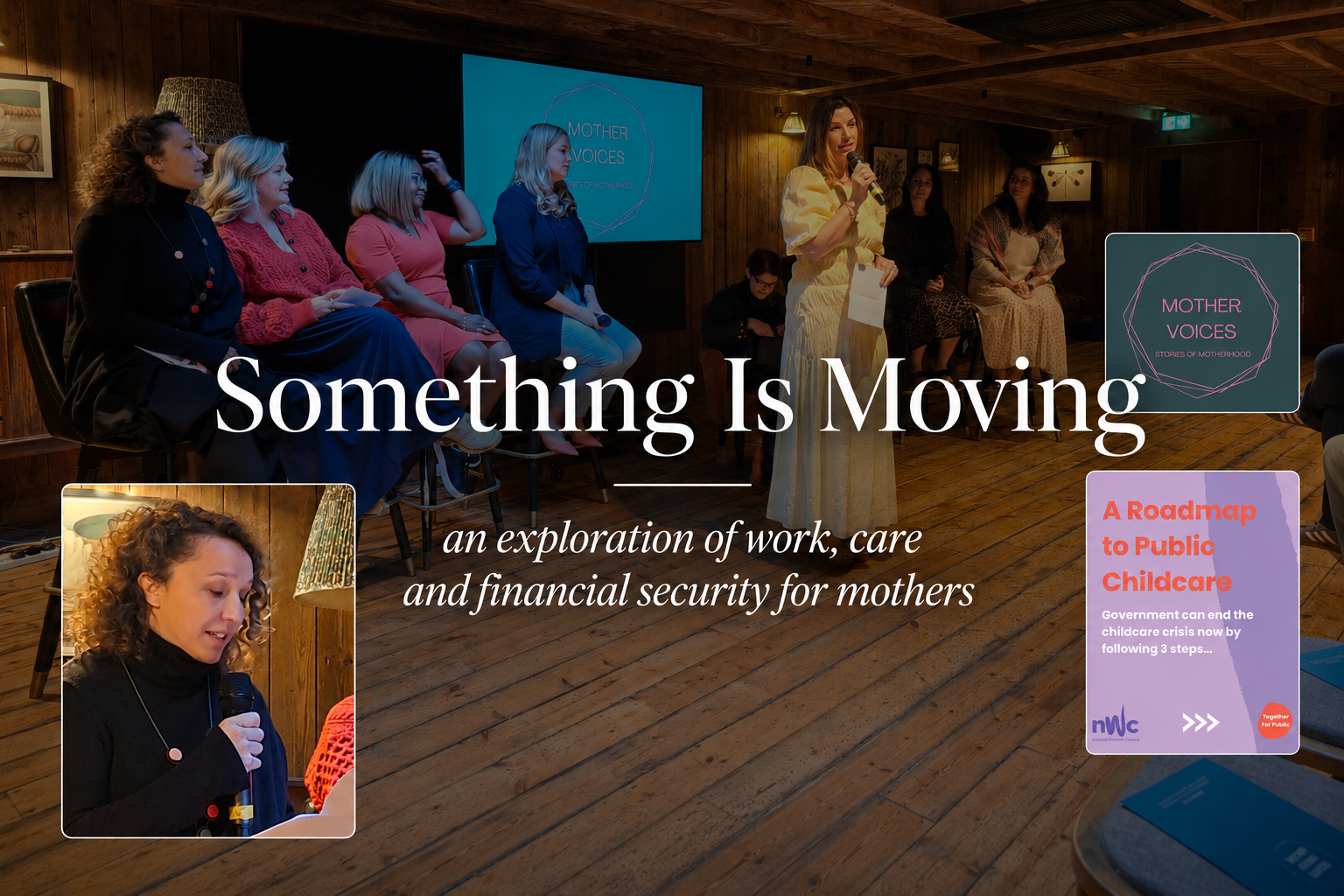
This week also marked World Maternal Mental Health Day, which made the timing of Mother’s Voices especially meaningful. The event was organised to raise funds and awareness for the Year of Care campaign by Aolish Gormley , which is calling for better recognition of what mothers need after birth, including physical, emotional, and mental support beyond the immediate postnatal period.
Alongside this, the National Women's Council (NWC) ’s Together for Public campaign is bringing renewed attention to the need for a public childcare system, and to the reality that childcare cannot continue to be treated as a private family problem.
These may appear to be separate conversations, but they are deeply connected.
Mothers do not experience care, childcare, work, recovery, confidence, mental health, and wellbeing as separate issues. They experience them together, in real life, often while trying to hold everything else around them together.
That is why this moment feels important. Not because everything has changed, but because more people seem to be naming the same thing from different places.
Mothers need support that is visible, structured, and public.
The Same Message From Different Places
What connects these conversations is the recognition that mothers are still too often expected to carry essential care privately, while the systems around them treat that care as separate from public policy, employment, childcare, health, and community wellbeing.
The Year of Care campaign is important because it asks us to look more seriously at what happens after birth, not only in the first few weeks, but across the first year, when many mothers are still recovering physically, adjusting emotionally, and carrying the daily reality of care with very little structured support.
The call for a public childcare system speaks to another part of the same issue. Childcare is often discussed as a service that parents need in order to work, but it is much more than that. It is part of the infrastructure that allows families to function, children to thrive, and parents, especially mothers, to participate in society with some level of stability and choice.
These conversations meet in the same place.
They both challenge the idea that mothers should simply manage, adjust, recover, organise, coordinate, and return to work as if care happens in the background without cost, impact, or consequence.
For a long time, many of these experiences have been treated as individual struggles. One mother unable to access childcare. One mother feeling isolated after birth. One mother unable to return to work. One mother losing confidence. One mother trying to hold the household together.
But when the same experiences appear again and again, across communities, campaigns, and conversations, they stop being individual problems. They become evidence of a system that has not yet been designed around the reality of care.
Why This Matters for Children Too
Supporting mothers is sometimes spoken about as if it sits separately from supporting children, but in real life those two things are deeply connected. Children do not grow up in isolation from the conditions around their mothers or primary caregivers. They grow within the emotional, financial, physical, and social environment that care creates.
When mothers are supported after birth, when they have access to recovery, connection, childcare, income, confidence, and practical help, that support does not stop with them. It shapes the home environment, the stability around the child, and the capacity of the family to manage daily life.
This does not mean placing responsibility for children’s outcomes solely on mothers. That would only repeat the problem in another form. It means recognising that if mothers are carrying so much of the care, then supporting mothers properly is one of the most direct ways to support children.
A mother who is isolated, exhausted, financially dependent, or left without support is not failing. She is operating within conditions that make care harder than it needs to be. A mother who is supported, connected, and recognised is better able to care from a place of stability rather than survival.
That is why these campaigns matter. They are not only asking for better services for mothers, but for a different understanding of what children and families need in order to thrive.
From Awareness to Structure
The encouraging part of this week is that these conversations are becoming more visible. The harder part is making sure they do not remain only as conversations.
Awareness matters, but mothers need more than awareness. They need structures that change what daily life actually looks like.
That means postnatal support that continues beyond the earliest weeks. It means childcare that is affordable, accessible, and treated as public infrastructure. It means employment pathways that recognise care, rather than expecting mothers to fit around systems designed without them in mind. It means community spaces where mothers can rebuild confidence, access information, meet others, reconnect with themselves, and be supported before problems become crises.
This is where public campaigns and local work need to meet.
Campaigns like Year of Care and Together for Public help move the conversation into public view, while local initiatives such as Ardu, Inner city Running club, Mums Hub and many more show what this can look like in practice at community level. Whether through spaces that support mothers’ wellbeing, movement and connection, or programmes that help mothers rebuild confidence and access pathways back into work, these initiatives recognise that mothers need support that reaches them in real life.
If systems are going to change, they need both public campaigns that shift understanding and local supports shaped by what mothers are actually experiencing, not only by what policy assumes they need.
Because support cannot only exist in principle. It has to reach mothers in practice.
A Week of Encouragement, and a Reminder
None of this means the work is done. The fact that these conversations are becoming more visible is encouraging, but visibility is only the beginning.
The next step is making sure that what is being named publicly is translated into systems that mothers can actually feel in their daily lives: support after birth that does not disappear too quickly, childcare that is treated as infrastructure, employment pathways that understand care, and local spaces where mothers can rebuild confidence, connection, and independence.
This week also brought encouragement closer to home, with Holly Cairns TD acknowledging the work Mums Hub is doing to support mothers into school-hour employment. For us, that recognition matters because it reflects something mothers have been saying clearly: flexible, practical pathways back into work are not a side issue, but part of how care needs to be recognised in real life.
If we want children to thrive, we cannot keep treating mothers’ wellbeing, recovery, confidence, financial independence, and access to support as secondary.
The conversation is moving.
Now the work is to make sure it leads somewhere.
This article is part of Karla’s wider series exploring care, work and economic security for mothers across Europe and Ireland.


