.avif)

.avif)
.avif)
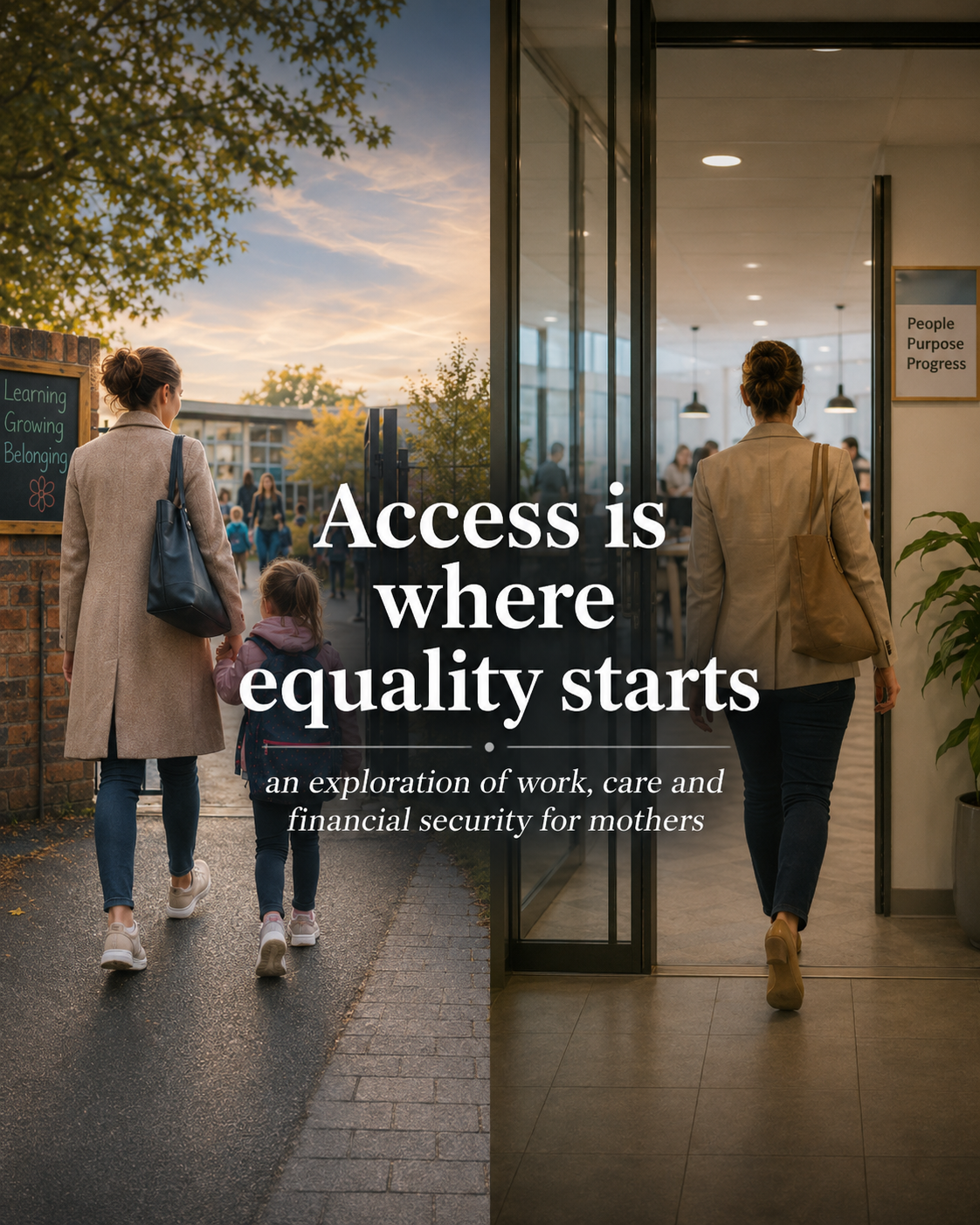
We talk a lot about the gender pay gap, and rightly so.
But before we can talk honestly about equal pay, progression, long-term financial security, or financial independence, we need to talk about access.
Access to work that mothers can realistically take. Access to childcare that makes employment possible. Access to income and safety. Access to support when children are small and care is constant. And access to real recognition for the unpaid care that holds families, communities, and the wider economy together.
Because if we really believe care is infrastructure, then mothers cannot keep being treated as if the work they do inside the home has no economic value.
The Gap We Need to Look at First
The gender pay gap matters. Women should be paid fairly. Women should be able to progress, move into leadership, build long-term security, and have their work valued properly.
But sometimes I feel that, for many mothers, we are starting the conversation too late.
Before a mother can build pay, progression, financial independence, or long-term security through paid employment, she has to be able to reach work in the first place.
And that is where so many mothers are being stopped.
Not because they are not ambitious. Not because they do not want to work. Not because they are not capable. But because the structure around work still assumes that someone else is available to carry the care.
It assumes childcare is available and affordable. It assumes school collections are covered. It assumes sick days can be absorbed easily. It assumes full-time availability is the default. It assumes that if a mother really wants to work, she will somehow make it fit. Start a little side hustle from home. Sell a few things on Vinted. Pick up bits and pieces around the edges of care.
And while there is nothing wrong with any of those things, they are not the same as access to stable, suitable work, income, progression, security, and financial independence.
But for many families, there is no “somehow”.
There are no childcare places. Or childcare costs more than the job would bring in. Or the hours do not match school hours. Or the role is too rigid. Or the mother has been out of paid work for years and needs a real route back in, not just another reminder that she should be working.
So when we talk about the gender pay gap, we also have to ask who is missing from that conversation.
What about the mothers who are not in paid employment at all because the system has made work unreachable? What about the women working far below their skills because those are the only roles that fit around care? What about the mothers who want to work, but cannot find anything that works with the reality of their children’s lives?
Those women are not always visible in pay gap conversations, but they are a big part of that story.
Because equality cannot only be measured by comparing the wages of people already inside the workplace. We also have to look at who is being kept outside the door.
And this is not only a personal loss for mothers and families. It is an economic loss too. The European Commission states that the economic loss due to the gender employment gap amounts to €370 billion per year, while Eurofound’s report found that the lower female employment rate cost the EU around €370 billion in 2013, equal to 2.8% of EU GDP.
Care Cannot Stay Invisible
There is another part of this conversation that we need to stop avoiding.
If we are serious about equality, then we have to talk about the monetary value of care.
Because right now, so much of the care that keeps families, communities, schools, workplaces, and the wider economy functioning is still done by mothers without direct pay, without enough financial protection in the present, and often without enough support.
That is not a small gap in the conversation. It is one of the foundations of the problem.
Raising children is work. Caring is work. Holding a family together is work. Managing appointments, meals, school runs, emotions, routines, sick days, homework, forms, clothes, lunches, and all the invisible planning behind family life is work.
And yet, because so much of it happens inside the home, it is treated as if it has no economic value.
Dr Catherine Conlon’s recent article on motherhood, childcare, and the value of care really speaks to this wider conversation, and I will link it here because these voices matter. Recent research referenced in that article placed the monetary worth of full-time care and household management at €57,140 a year, including childcare, cleaning, cooking, teaching assistance, transport, and other everyday work that keeps family life functioning.
Most mothers did not need a study to tell them that this is work. They live it every day.
But having a figure attached to it matters, because it helps make visible what has been invisible for too long.
There is some recognition of caring later through things like HomeCaring Periods, and that matters. But recognising care in a pension record is not the same as giving mothers financial stability while they are actively doing the work of care.
It is not the same as income.
It is not the same as independence.
And it is not the same as valuing care fully.
If care is infrastructure, then it cannot be praised in speeches and ignored in budgets. It needs recognition. It needs investment. It needs policy. It needs financial value attached to it.
Mothers should not become poorer, less secure, or more dependent because they are doing the work society relies on.
Mothers’ Stability Matters Too
We also need to remember that supporting mothers is not separate from supporting children.
Children need stable, healthy adults around them. They need care, attention, routine, safety, and love. But they also need to see their mothers as whole people, not only as people who serve everyone else.
Mothers are human beings. They need friendship, confidence, community, purpose, rest, income, and a sense of their own worth. They need to be able to model connection, self-respect, and participation in the world around them.
Humans are social beings, and mothers are no different.
When mothers are financially insecure, isolated, unsupported, or constantly trying to survive without enough help, that pressure does not stay neatly with the mother. It affects the whole family.
That is not because mothers are failing.
It is because care cannot be carried endlessly without support.
We talk a lot about children’s wellbeing, but we do not always talk enough about the conditions mothers are raising children in. Healthy, supported, financially stable mothers are more likely to raise healthy, secure children. Not because money solves everything, but because stability, dignity, and support change the emotional climate of a home.
Supporting mothers means supporting children too.
It means recognising that healthy families are not built only through services for children, but also through stability, income, community, and dignity for the adults raising them.
Access Can Also Be a Safety Issue
There is another reason financial stability matters, and it is one we cannot ignore.
For some mothers, access to income and suitable work is not only about career progression or personal development. It is about safety, choice, and the ability to leave situations that are harmful.
Mothers are often at their most vulnerable when children are small and dependent on them for everything. You cannot leave young children at home and go to work. You cannot build financial independence if there is no childcare place, no flexible role, no family support, and no realistic pathway into employment.
When mothers are locked out of work, they can also be locked into dependence.
And for women experiencing domestic abuse, coercive control, or financial abuse, that dependence can become dangerous. Women's Aid Ireland and other organisations have been warning for years about the impact of financial abuse and control. When a woman has no income of her own, very few options, and children depending on her, leaving an unsafe situation becomes much harder.
This is even more difficult for mothers in emergency accommodation.
After speaking with the team in Focus Ireland, I came away with yet another understanding of how impossible some situations can become. If a mother cannot have someone come in to mind the children, cannot access childcare, and cannot take work outside school hours, then her options become painfully limited.
For some mothers, school-hour work is not a preference.
It is the only realistic window they have.
And still, mothers are expected to somehow make it work.
This is why access matters so much. Not as a nice idea, but as a practical route to safety, confidence, income, and choice.
Where Mums Hub Fits
This is where Mums Hub comes in.
We meet mothers where they are.
That means listening first, understanding each mother’s individual situation, and looking at what she actually needs. For one mother, that might be help with confidence, a CV, or preparing to return to work. For another, it might be information, connection, signposting, or simply being heard properly without judgement.
Where we can help directly, we do. Where another service is better placed to support, we signpost.
But Mums Hub is not only about individual support. It is also about advocacy.
We advocate for family-friendly workplaces, school-hour roles, flexible employment, and real pathways back into work for mothers who have been locked out by care, childcare costs, rigid hours, or lack of support.
We also believe part-time jobseekers should be recognised properly as jobseekers, and able to access the supports available to others trying to return to work. For many mothers, part-time or school-hour work is not a lack of ambition. It is the only realistic route back into employment while children are small, childcare is limited, or care responsibilities are constant.
And we advocate for something even deeper than that: for care to be recognised as infrastructure, and treated as such.
Because if care is what allows children to grow, families to function, communities to hold together, and the wider economy to keep moving, then it cannot continue to be treated as invisible private work carried mainly by mothers at their own financial cost.
Care needs recognition. It needs investment. It needs policy. It needs financial value attached to it.
Mums Hub is not here to pretend this conversation is new. Many women, researchers, advocates, and organisations have been naming these issues for a long time.
Mums Hub is here because the conversation needs to move into practical action.
We need to keep talking about the value of care, but we also need to build around it: access to suitable work, recognition for unpaid care, affordable and available childcare, family-friendly workplaces, school-hour roles, flexible employment, and support that meets mothers where they actually are.
Because mothers do not need another lecture about ambition.
They need access, support, recognition, and systems that understand the reality of care.
This article is part of Karla’s wider series exploring care, work and economic security for mothers across Europe and Ireland.


